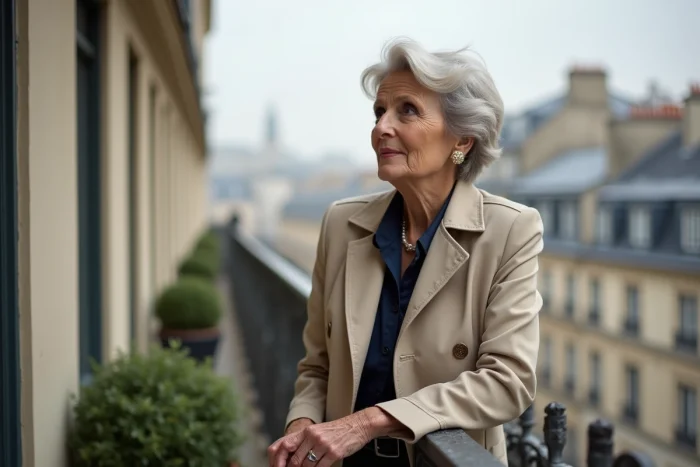
1973. Anne Dewavrin says yes to Bernard Arnault. At that time, the LVMH empire does not yet exist in the wildest dreams of Place Vendôme. Their story, marked by the birth of two children, precedes the rise of a man destined to reshape the face of French luxury.
Not often present in the press, Anne Dewavrin nonetheless left a decisive mark during these pivotal years. After the separation in 1990, she chooses to withdraw, while continuing, away from prying eyes, personal and family commitments that are largely unknown.
Anne Dewavrin, a discreet personality at the heart of a large family
Roubaix, 1950. Anne Dewavrin is born into a family of industrialists firmly rooted in the North. Here, success is not shouted from the rooftops; it is whispered at the family table. No showiness or pretense: discretion is second nature. The Dewavrin legacy extends beyond the factory walls; it shapes a way of being, marked by reserve, consistency, and a loyalty that is almost organic. Between France and the United States, Anne Dewavrin travels but keeps her compass pointed towards her Roubaix roots. Faced with the spotlight, she prefers the shadows. This preference is not trivial: she leaves her mark in Arnault’s circle, where few allow themselves to be reserved. Through this stance, Anne Dewavrin lays the groundwork for a silent influence that asserts itself over time. She becomes an essential balance point in a family that has always been wary of ostentation. Her journey commands respect for its ability to embrace the times without ever betraying her heritage. Her private life remains carefully distanced, which only fuels the curiosity of those observing the Arnault dynasty. To learn more about Anne Dewavrin, one must be interested in how she has managed to preserve her uniqueness while supporting, in her own way, the rise of an industrial dynasty.
What role did she play alongside Bernard Arnault and in the education of their children?
The meeting of Anne Dewavrin and Bernard Arnault in the 1970s seals a shared destiny. Their marriage in 1973 precedes the industrialist’s takeover of the luxury sector. There is no need for Anne Dewavrin to sit on the board of directors: it is within the home, in the transmission of values and the building of a solid education, that she exerts her influence. Two children are born: Delphine Arnault in 1975, and then Antoine Arnault in 1977. She ensures, far from the hustle and bustle of business, to create an environment conducive to her children’s development. Demands, rigor, discretion, love of culture, and the French language become guiding principles. Anne Dewavrin does not settle for providing material comfort: she imparts a sense of responsibility, fidelity to a certain idea of family and duty.
These principles are reflected today in her children’s paths:
- Delphine Arnault, now at the helm of Christian Dior Couture and a leader at Louis Vuitton, embodies the quiet strength and elegance inherited from her mother.
- Antoine Arnault, CEO of Berluti, president of Loro Piana, and head of communications at LVMH, cultivates this ethic forged at home.
Anne Dewavrin remains outside the realm of public honors, but her presence, for Delphine and Antoine, remains that of a silent reference. She does not appear on any organizational chart, but her impact within the Arnault clan has been deeply rooted over time, discreet yet decisive.
From shadows to legacy: what life after divorce reveals about her lasting influence
The separation of Anne Dewavrin and Bernard Arnault in 1990 did not erase her imprint. She moves forward quietly towards her own story, remarrying Patrice de Maistre, a wealth manager, and now splits her time between France and the United States. This mobility reflects an assumed openness but also an integration into networks where philanthropy, education, and social innovation hold a prominent place. Anne Dewavrin engages in projects far from the cameras, refusing to give in to media temptation. She invests in education, is interested in social innovation projects, and sometimes discreetly supports young talents taking their first steps. Her commitment, often invisible, is expressed in think tanks, foundations, or grassroots actions, always guided by a humanistic vision and fidelity to her values. After being Bernard Arnault’s first wife, she continued to build, in discretion, the foundations of a family whose commitment and success are no accident. Her relationship with her children remains marked by transmission, rigor, and respect for duty. Even when Bernard Arnault rebuilds his life with pianist Hélène Mercier-Arnault, there lingers in the success of the new generation a unique scent, inherited in whispers, from a mother who remained true to herself. Nothing truly fades in the family history: some legacies are passed down quietly but last longer than grand declarations.