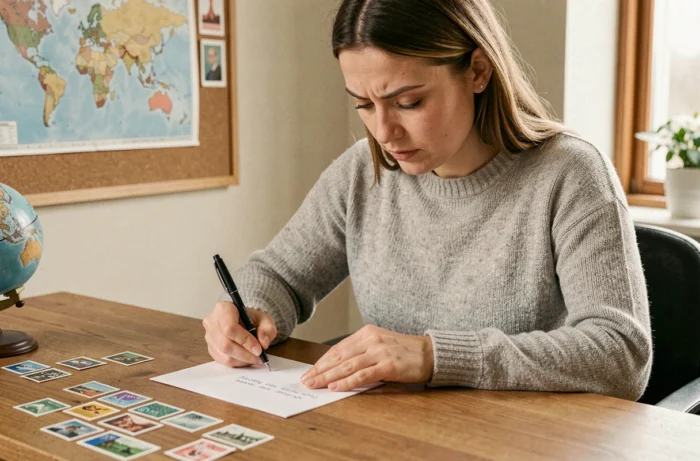
A parcel sent to Japan with a street number on the first line and the country at the bottom, as you would do for France, is likely to get stuck at a sorting center.
International addressing is about more than translating an address: each country has its own order, postal code format, and sometimes a radically different way of identifying locations. Following the destination country’s address format can make the difference between a parcel delivered within a few days and one returned to the sender.
Address forms and automated sorting: how data entry affects delivery
People often assume that mistakes happen when writing on the envelope. In reality, the problem starts earlier, when entering the address in an online form or shipping software. A required “street” field does not work for every country: in Japan, addresses are organized from the largest area (prefecture) to the most specific (block and building number), without referring to a street name in the European sense.
An overly rigid form forces the sender to split the address in an artificial way. The result may pass the system’s validation, but become unreadable to the postal sorting system in the destination country. For a contact database or shipping tool, keeping several free-form address lines and a separate country field reduces this risk. This approach is recommended by the Universal Postal Union (UPU) in its description of address elements.
Before preparing an international shipment, it saves time to write an international postal address using the format expected by the local postal operator rather than the French model.
International postal codes: placement and prefixes by destination country
The postal code is the element that varies most from one country to another, and it is the one most likely to cause automated sorting rejections. Two common pitfalls come up again and again.
Where the postal code goes in relation to the city
In France, the postal code comes before the city on the same line. Germany uses the same format (postal code, then city). In the United Kingdom, the postcode goes below the city on a separate line. In the United States, the ZIP code follows the city and state abbreviation on the last line before the country.
Using the French format everywhere means providing an address that the sorting machine may not recognize. The basic rule: follow the order used in the destination country, not the country of origin.
Country prefixes you should not add
Shipments to Germany still sometimes show a postal code preceded by “D-” or “DE-”. This practice, inherited from older conventions, is now discouraged by the UPU addressing guides shared by DHL. The prefix interferes with optical reading and can send the item to the wrong sorting center. The rule is simple: write the postal code on its own, without a country letter in front.
Postal addresses in Japan and countries without street names: adapting the shipment format
Japan perfectly illustrates why a single addressing format does not work everywhere. Japanese addresses do not start with the street and end with the city: they go from the broadest area (prefecture, city) to the most specific (district, block, building number). Streets are generally not used as numbering references.
When sending a letter or parcel to Japan from France, you can romanize the address (transcribe it into Latin characters). But an approximate romanization can make the address unusable on arrival. Checking the transcription with the recipient remains the most reliable approach.
Japan is not the only example. Several countries in the Middle East and Africa use systems where locations are identified by landmarks, neighborhood names, or post office boxes rather than a street number and name. For these destinations, forcing an “number, street, city” format results in truncated addresses.

Writing the address on the envelope: the layout rules that really matter
Beyond the address details themselves, how they are physically laid out on the envelope directly affects postal processing. Three points deserve particular attention.
- Put the destination country on the last line, in uppercase. This is the first information read by the international sorting center. Write the country in the language of the country of origin or in English (both are accepted). For example, from France, write “ALLEMAGNE” or “GERMANY”, never “Deutschland”.
- Place the recipient’s address in the lower-right half of the envelope. Put the sender’s address in the upper-left corner or on the back. Keeping the two areas separate avoids confusion for optical readers.
- Use uppercase without accents for the city and postal code lines. Sorting machines read unaccented characters more reliably on these lines. The rest of the address (recipient’s name, street) can use normal capitalization.
The same principles apply to parcels. Just make sure the label is attached to the largest side of the package, without folds or partial overlap.
International B2B addresses: extra lines you should not forget
Business shipments to a foreign company often require additional identification lines that are not needed for shipments between individuals. The recommended structure puts the company name on the first line, followed by the recipient’s name or relevant department, then any additional location details (building, floor, industrial estate).
Leaving out the department name at a large company can delay internal delivery by several days or even result in the item being returned. For shipments to countries where post office boxes are more common than physical addresses (some Gulf countries, for example), the post office box replaces the street line; do not include both.
An international address should have no more than six lines in total. Beyond that, some sorting machines may not read the last lines correctly. If the address needs more detail, combine additional information on one line, separated by a comma.
One final point that is often overlooked: the recipient’s phone number. It does not appear on the envelope, but private carriers routinely require it for international parcels. Adding it when entering the address helps prevent delays at customs or during final delivery.