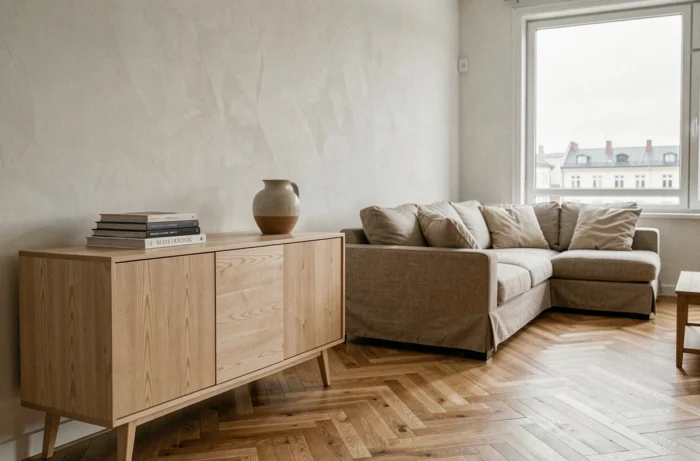
Choosing elegant and functional furniture for your interior relies less on a crush and more on a set of measurable criteria: room dimensions, material properties, actual furniture durability, and compatibility with upcoming standards. This article compares these parameters to help you balance aesthetics and everyday use.
ESPR Regulation and Digital Passport: What Changes for Furniture
The European regulation (EU) 2024/1781, known as the Ecodesign for Sustainable Products Regulation (ESPR), came into effect on July 18, 2024. It replaces the old Ecodesign directive from 2009 and now applies to almost all physical goods, including furniture.
The European Commission’s 2025-2030 work plan designates furniture (including mattresses) as a priority product. By 2030, furniture sold in Europe must meet mandatory requirements for durability, reparability, recycled content, and recyclability.
For a purchase today, this means prioritizing dismountable furniture, where parts can be individually replaced. A piece of furniture glued irreversibly or made of non-separable panels risks becoming an obsolete product in light of these future obligations. The catalogs of Maison Du Meuble allow you to filter furniture according to these sustainable design characteristics.
The regulation also provides for the introduction of a Digital Product Passport. Each piece of furniture will carry an identifier tracing its composition, materials, origin, and repair options. This system will change the way furniture is compared before purchase, well beyond just aesthetic criteria.

Furniture Materials: Durability and Maintenance Comparison
The choice of material determines the appearance, longevity, and maintenance effort of a piece of furniture. The table below summarizes the differences between the most common material families for living room or dining room furniture.
| Material | Estimated Durability | Maintenance | ESPR Compatibility |
|---|---|---|---|
| Solid wood (oak, walnut) | Very high | Periodic sanding and oiling | Good (repairable, recyclable) |
| Melamine board | Medium | Simple (damp cloth) | Low (difficult to recycle) |
| Metal (steel, aluminum) | High | Standard cleaning | Very good (infinitely recyclable) |
| Natural rattan | Medium to high | Dusting, moisture protection | Good (bio-based material) |
| Laquered MDF panels | Medium | Fragile to shocks, gentle cleaning | Low (non-separable composite) |
Solid wood and metal show the best longevity and the strongest compatibility with future eco-design standards. In contrast, melamine and MDF panels, often cheaper, pose a recyclability issue that regulations will increasingly tighten.
The Case of Rattan and Bio-based Materials
Rattan is making a strong comeback in interior decoration. Its lightness allows for easy movement, making it suitable for multi-purpose rooms. Its main limitation remains its sensitivity to moisture: a rattan piece placed in a humid room will deform within months. For a living room or bedroom, the style-functionality ratio is favorable. For a bathroom or covered garden, treated metal or teak remains more suitable.
Proportions and Space: Costly Mistakes
Competing guides repeat that you should measure your room before buying. The advice is correct, but rarely put into perspective. The proportion between the furniture and the free space around it determines the circulation and visual comfort of the room.
- A sofa whose depth exceeds one-third of the width of the living room creates a corridor effect and blocks circulation to other areas
- A coffee table that is too high compared to the sofa seat (more than a few centimeters above) disrupts ergonomics and gives the impression of mismatched furniture
- A storage unit placed against a load-bearing wall without lateral clearance prevents the full opening of doors and reduces useful storage capacity
The ratio of free space to furnished area should remain above half of the floor area for a room to maintain a sense of openness. When this ratio decreases too much, even designer furniture loses its aesthetic effect.
Adjusting Furniture Height to Room Volume
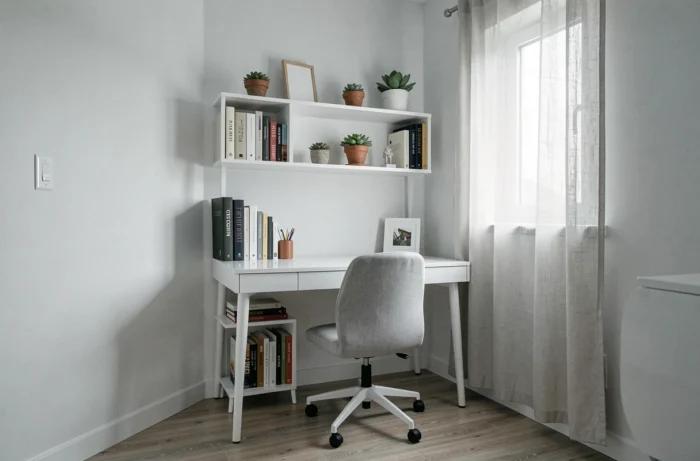
In a room with standard ceiling height, a tall piece of furniture (bookshelf, display cabinet) emphasizes verticality and can visually overwhelm the rest of the furniture. Conversely, in a space with large volumes, exclusively low furniture creates an imbalance. Mixing at least two heights of furniture in the same room restores a coherent proportion.
Decorative Style and Furniture Consistency: Cross-referencing Criteria
The decorative style (modern, Scandinavian, industrial) is not an isolated criterion. It interacts with materials, finishes, and color palettes.
A piece of raw black metal furniture fits into an industrial or modern interior but creates a break in a bohemian or classic decor. A light wood piece works in a Scandinavian style but may seem bland in a living room with dark walls. Consistency between material, furniture color, and wall tone is the most often overlooked parameter.
- Modern style: favor straight lines, materials like metal or glass, and neutral colors
- Scandinavian style: light wood (birch, pine), natural textiles, pastel palette
- Industrial style: exposed steel, raw or recycled wood, matte finishes
- Classic style: dark wood (cherry, mahogany), curves, molded details
Choosing a style should not become a rigid constraint. A piece of furniture with a character different from the rest of the room can work as an accent piece, provided it remains the only dissonant element. Two pieces of opposing styles in the same room create visual disorder, not personality.
The ESPR regulation will gradually make visible data that has been absent from product sheets: origin of materials, recyclability rate, estimated lifespan. Once accessible via the digital passport, this information will become comparison criteria as concrete as price or dimensions. A piece of furniture chosen today with these parameters in mind will retain its relevance well beyond current decor trends.