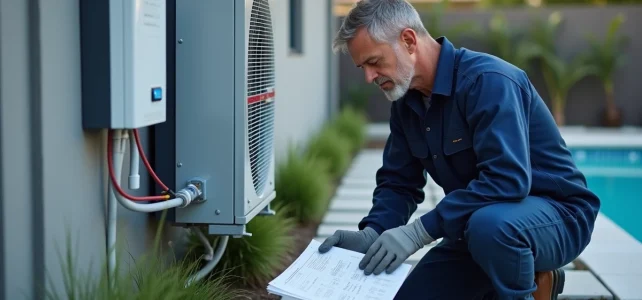
The electrical connection of a swimming pool heat pump (PAC) is not just about pulling a cable between the main panel and the device. The cross-section of this cable determines the safety of the installation, the longevity of the equipment, and compliance with the NF C 15-100 standard. Choosing an inappropriate cross-section exposes one to overheating of the conductor, unexpected tripping of the circuit breaker, or even a fire risk.
Inrush current of Inverter PACs: the parameter that standard tables ignore
Most online guides provide a table crossing nominal current and distance to determine the cable cross-section. These tables work for simple resistive loads, but modern swimming pool PACs, especially Inverter models, present a significantly higher inrush current than the nominal current.
Related reading : How to Choose the Right Window Color to Enhance Your Home in Brittany
Hayward, in its HeatExpert Inverter installation manual (version 1.3, 2023), explicitly mentions this phenomenon. At startup, the compressor draws a peak current that can far exceed the stabilized operating value. If the cable cross-section and circuit breaker rating are sized solely based on the nominal current, the circuit breaker may trip every time it starts, or worse, the cable operates beyond its allowable thermal capacity for a few seconds with each cycle.
Before consulting a general table, one should read the manufacturer’s manual for the specific PAC. The inrush current is listed there, and it is this value that determines the actual sizing of the circuit. A guide detailing the cable cross-section for swimming pool heat pumps allows for cross-referencing this data with the planned cable length.
See also : Active parents: how to find the rare gem to care for your children
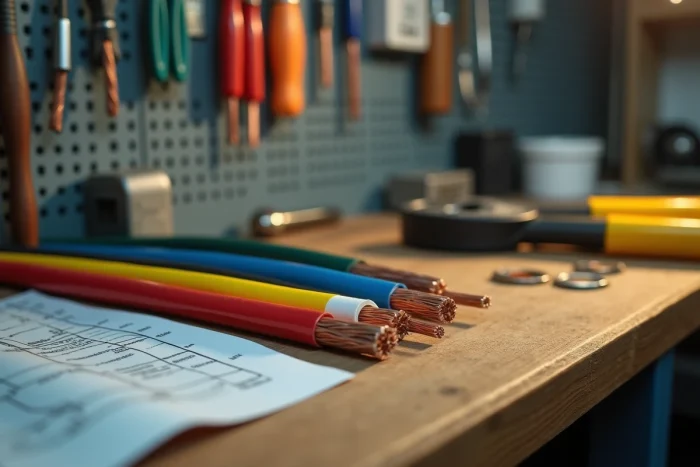
Correction factors: why the temperature of the technical room changes everything
The UTE C 15-559 guide (2021 edition), specific to swimming pool installations, reminds us of a constraint often absent from mainstream articles: the allowable current of a cable depends on the installation conditions. The theoretical cross-section derived from a table is only valid under standard temperature and ventilation conditions.
In a swimming pool technical room, several factors degrade the capacity of the cable:
- The ambient temperature of the room, which can rise significantly in summer, especially if the room is small, poorly ventilated, or exposed to sunlight. The hotter the ambient air, the less the cable dissipates its heat.
- The installation method: a cable run in buried conduit, in a closed duct, or grouped with other circuits sees its allowable current reduced by correction factors defined by the NF C 15-100 standard.
- The proximity of other power cables (filtration pump, electrolyzer, lighting) that also generate heat and reduce mutual thermal dissipation.
The concrete result: a cable with a sufficient cross-section on paper can become undersized under the actual conditions of the room. This is why a qualified electrician systematically applies these correction factors before validating a cross-section.
30 mA Type A Differential: a normative requirement for Inverter PACs
The NF C 15-100 standard, in its consolidated version of 2022, mandates a 30 mA differential device to protect individuals. However, not all 30 mA differentials are created equal. For PACs equipped with an Inverter compressor (variable speed technology), a Type A differential is required, not a simple Type AC.
Difference between Type AC and Type A
A Type AC differential only detects sinusoidal alternating leakage currents. Inverter PACs use power electronic components (rectifiers, inverters) that can generate leakage currents with a direct current component. A Type AC differential does not detect them, creating a silent protection fault.
Type A detects both alternating leakage currents and pulsed leakage currents with a direct current component. The NF C 15-100 standard (§531.3.3) requires it for circuits supplying power electronic equipment. Installing a Type AC on an Inverter PAC means not properly protecting the circuit, even if the differential trips in some cases.
In practice, field feedback varies on the actual frequency of unexpected trippings related to the wrong type of differential. Some installers never observe issues with a Type AC, while others report unexplained trippings that cease after replacement with a Type A. The standard resolves this ambiguity by mandating Type A.

Cable cross-section and distance: the reliable calculation method
The correct sizing combines three data points: the maximum current absorbed by the PAC (including inrush current), the length of cable between the electrical panel and the PAC, and the correction factors related to installation conditions.
The two normative criteria to be respected simultaneously
The NF C 15-100 standard requires checking two criteria for each circuit:
- The voltage drop at the end of the line must not exceed a defined threshold (generally a few percent of the nominal voltage). The longer the cable, the greater the voltage drop, and the larger the cross-section must be to compensate.
- The heating of the cable during continuous operation must remain within the limits of the insulation. This is where the corrected allowable current (after applying temperature, grouping, and installation method coefficients) comes into play.
The most constraining of the two criteria determines the final cross-section. Over a short distance, it is often the heating that sizes it. Over a long distance (several tens of meters between the panel and the PAC), the voltage drop takes precedence and imposes a larger cross-section.
Rigid or flexible cable: which type to use
For an installation in a humid area like a swimming pool technical room, the cable must comply with the H07 RN-F standard (flexible rubber-sheathed cable), suitable for humid environments and outdoor passages. A standard domestic cable of type H07 VU (rigid under sheath) is suitable for protected indoor routing but not for sections exposed to water splashes or buried without appropriate conduit.
The choice between single-phase and three-phase depends on the power of the PAC and the available supply. High-power PACs (beyond a certain intensity on the single-phase network) require a three-phase connection, which changes the required cross-section and the type of circuit breaker.
The cable cross-section for a swimming pool PAC cannot be read from a single table. It results from a calculation that integrates the actual inrush current, the distance, the temperature of the room, and the installation method. Having this calculation validated by an electrician remains the only guarantee of compliance with the NF C 15-100 standard.