
In 2023, 62% of French higher education institutions reported offering at least one program that combines in-person and distance learning, whereas this figure was below 20% in 2018. Several universities today impose quotas for hybrid courses in their curricula, driven by institutional recommendations and the reform of continuing education.
The regulatory framework is evolving faster than practices. Digital tools, initially designed to address urgency, are now integrated into pedagogical design. Some educators find that the boundary between innovation and constraint is becoming blurred, while students are getting used to increasingly flexible learning formats.
Hybrid Teaching in Higher Education: Observations, Challenges, and Recent Changes
In higher education, change is becoming more pronounced year after year: hybrid training is advancing rapidly and is now available in multiple formats, combining in-person and remote learning. The DiU Hybridizing Teaching in Higher Education (H2ES), developed by USCHOOL in collaboration with the Polytechnic University of Hauts-de-France and offered in Lille, supports educators in the development and implementation of hybrid programs. The goal is no longer just to add digital elements, but to transform the way of learning, enhance student engagement, and rethink the pedagogical relationship.
Habits are changing quickly. The typology of hybrid programs, developed as part of the Hy-Sup project and later updated by HyPES, now identifies several models: from simple digital tool provision to advanced integration of resources and remote interactions. This mosaic reflects the variety of contexts, university profiles, and student needs. Hybridium Santé, for example, offers three pathways: understanding hybridization, creating content, and facilitating a hybrid program. These approaches rely on stable and scalable platforms, such as the Moodle of INSA Rouen, which is now essential for structuring a program and opening up new pedagogical perspectives.
The challenges focus on the quality of mediation and follow-up. Pedagogical scenario design becomes the cornerstone for ensuring coherence between objectives, activities, and assessments. Educators learn to integrate digital resources step by step, while students develop their autonomy and engage in collaborative work. Academic publications and analyses by Charlier and Deschryver emphasize the necessity of collectively rethinking the articulation between programs, resources, and the organization of learning time.
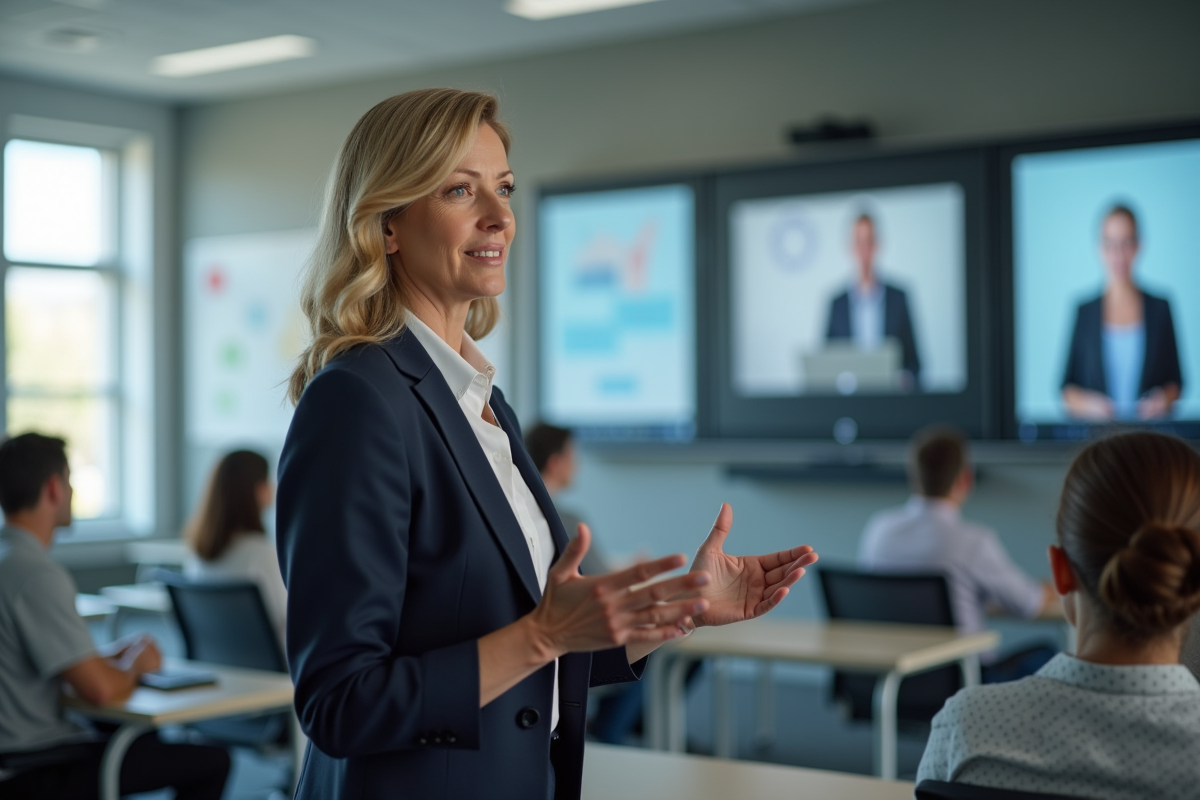
What tools and methods are transforming students’ educational experiences today?
Hybrid training in higher education relies on a convergence of digital tools and revisited methods. Online learning platforms have established themselves as true digital campuses: they enable monitoring, interaction, and resource sharing. Each module, each pathway, is organized around a precise scenario: planned tasks, clear objectives, assessments adapted to the rhythms and expectations of students.
In addition, artificial intelligence is gradually becoming a daily ally. AI adapts content, identifies bottlenecks, and highlights successes. A hybrid-AI framework is emerging around four phases: needs analysis, enriched pedagogical design, deployment with support, and continuous evaluation. The educator evolves into a guiding role, supporting students in a journey where autonomy and interactivity are paramount.
To better understand the diversity of tools being utilized, here are those that are progressively becoming standard in practices:
- Digital resources: videos, interactive quizzes, case studies, gathered in the Hybridium library.
- Collaborative tools: forums, virtual classrooms, synchronous and asynchronous workshops that stimulate exchanges.
- Formative assessment: continuous monitoring, enriched by learning analytics and personalized feedback.
Active pedagogy is gaining momentum. In-person and remote learning combine seamlessly, without disruption. Students engage, experiment, and build their own knowledge in an environment where personalized support and continuous improvement are no longer optional. The initiatives led by Vincent Six or Hybridium Santé illustrate this desire to renew methods, without succumbing to technological ease, but with the compass of individual empowerment and collective transformation. Higher education is no longer just following the movement: it is shaping it, a little more each day.