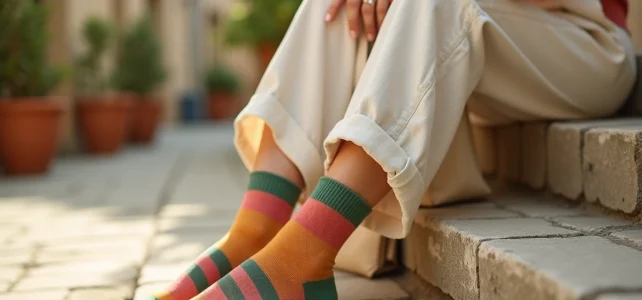
When you have wide or sensitive feet, buying a trendy pair of socks can sometimes feel like a gamble. The fit is too tight, the elastic digs into the ankle, the pattern distorts after three washes. The spring-summer 2026 collections provide concrete solutions to these issues, as long as you know where to look.
Socks 2026 and foot shapes: what really changes this season
Until now, brands offered a one-size-fits-all or a duo S/M – L/XL, without distinguishing width. Several premium manufacturers are now incorporating differentiated expansion zones at the metatarsal level, allowing a fancy sock to adapt to both narrow and wide feet without distorting the pattern.
Further reading : Essential Finance Trends for 2024 to Better Manage Your Money
For sensitive feet, we note the emergence of flat seams at the toe on models that remain aesthetically pleasing. This is no longer reserved for medical ranges. If you’re looking for the new spring summer 2026 socks that combine style and comfort, this finishing criterion should be checked first.
Feedback varies on this point among brands, but the consensus on the ground is clear: a sock with a Y-shaped heel stays on a narrow foot better than a tubular model, even a high-end one.
Recommended read : Tati Wedding Dresses 2024: Discover the Must-Have Trends and Styles
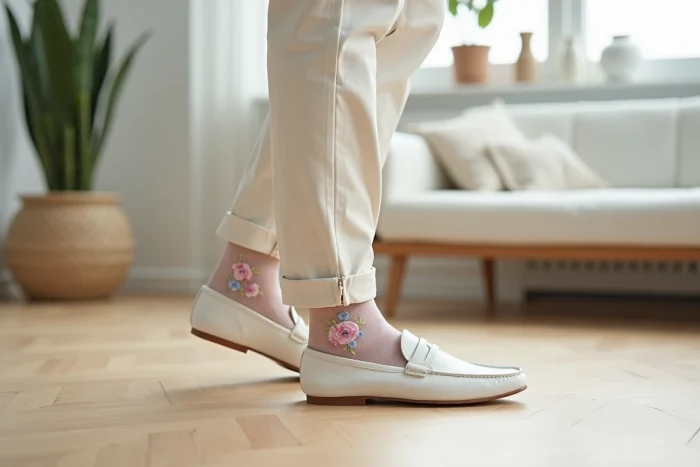
Recycled fibers and EU labeling: read the composition before splurging
The European regulation 2025/1234, which came into effect in March 2026, mandates detailed labeling on the composition and origin of textile fibers. For socks, this means we can finally compare two pairs objectively before purchase.
In practice, labels now show the exact proportion of recycled polyamide, organic cotton, or bio-sourced fibers. The “Sustainable Fashion Trends 2026” report from WGSN confirms that recycled fibers have dominated premium collections since fall-winter 2025.
What the composition reveals about summer comfort
A sock labeled with a majority of recycled polyester without a breathable blend will keep warm. For spring-summer, we prefer blends where organic cotton or linen is the dominant fiber, complemented by a portion of elastane for support.
- Organic cotton or linen as the main fiber: maximum breathability in hot weather, suitable for reactive skin
- Recycled polyamide in heel and toe reinforcement: abrasion resistance without sacrificing flexibility
- Elastane kept below ten percent: proper support without excessive compression on a wide foot
Checking the composition is not tedious when the label is finally readable. It’s the best reflex to avoid socks that end up at the bottom of the drawer after a day of wear.
Durability of fancy socks: reinforced patterns and finishes
The “Mode Insider” podcast (episode 47 with Linda Sommet, May 2026) highlighted a recurring issue: complex patterned socks wear out prematurely after ten to fifteen washes. The pattern deteriorates, colors fade, and the pair loses all stylistic interest.
Brands that have taken this feedback seriously offer two solutions. The first: jacquard woven patterns rather than surface-printed ones. The second: mass-dyed threads, whose color withstands washing cycles much better.
Check before buying: three concrete points
When you spot a pair with a pattern you like, check the manufacturing technique. A jacquard pattern is recognizable on the inside of the sock: you can see the colored threads running from one edge to the other. A simply printed pattern has a uniform back.
- Jacquard or intarsia: the pattern is part of the knit structure, it won’t fade in the wash
- Heel-toe reinforcement in doubled thread: a sign that the manufacturer has anticipated mechanical wear
- Soft ribbed cuff without visible elastic: less marking on the ankle, better long-term support
- Recommended wash at 30 °C on the label: confirms the presence of heat-sensitive technical fibers

Technical anti-odor socks: the right choice for a sportswear-chic look
Sportswear-chic remains a strong trend for spring-summer 2026. Visible socks are worn with low sneakers, open mules, and sometimes sandals. In this configuration, the anti-bacterial treatment becomes a choice criterion as legitimate as color.
The “Footwear and Accessories Innovation Report Q1 2026” from the NPD Group notes that technical anti-odor socks are gaining popularity well beyond the sports aisle. They integrate into everyday looks, with varied colors and heights.
Adapting the sock height to your outfit
The invisible micro-sock is suitable for loafers and low sneakers. The mid-calf sock, worn visibly, works with shorts or a midi skirt. For a wide foot, the mid-calf offers better support because it distributes pressure over a larger surface.
On a narrow foot, be cautious of models that are too loose in a low height: they slip into the shoe and create uncomfortable folds. In this case, a sock with silicone grip at the heel is preferred, a detail that has become common in the 2026 ranges.
The sock trends this season are not just about color or pattern choice. The composition, manufacturing technique, and adaptation to foot morphology determine whether a pair will last all summer or end up abandoned after two weeks. Better to have three well-chosen pairs than a drawer full of socks that you never wear.