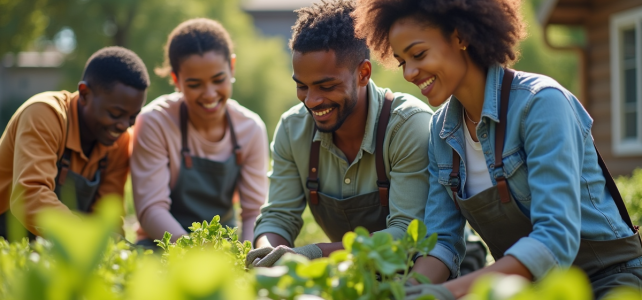
In Lyon, over 500 citizen initiatives have emerged in five years, according to figures from the local mutual aid network. Institutional measures struggle to address certain social urgencies, but informal groups fill these gaps with concrete actions.
Collectives organize meal distributions, while others set up learning workshops or short food distribution circuits. This local dynamic relies on networks of volunteers and constant commitment, often overlooked by official channels.
Why citizen initiatives are transforming the social fabric in Lyon
In Lyon, citizen initiatives nourish the social fabric and create new balances. Associations, collectives, and actors in the social and solidarity economy embrace ecological transition with a keen sense of the concrete. Here, change is not just a slogan: it unfolds in daily actions, in the adaptation of lifestyles, in the ability to invent together. Ecological planning, promoted by the French state and the Bourgogne-Franche-Comté region, relies on this energy to accelerate the emergence of unprecedented social solutions.
The Citizen Initiative Factory encourages the creation of projects rooted in the daily lives of residents. A striking example: the POTES Network, federated among others by Energy Cities and ADEME BFC, demonstrates what the alliance between institutions and civil society can produce when energies converge. Fragile urban neighborhoods are not left behind: IREV and COPAS scrutinize, analyze, and support, revealing residents’ ability to transform their living environment.
This movement thrives in the margins, documented by independent media or relayed by platforms such as the blog Un Cœur Pour La Paix. Through these echoes, a more inclusive society takes shape. Here, solidarity is not decreed; it is built, patiently, through collective initiatives, mutual aid, and a fierce determination to address the social, economic, and environmental challenges that punctuate daily life.

Spotlight on inspiring solidarity projects and how to get involved concretely
Across France, solidarity projects are unfolding and redefining how social bonds are created. In Saint-Gildas-de-Rhuys, the Camping du Hallate proves that hospitality can be reimagined by protecting natural resources and promoting governance where every voice counts. Montpellier sees the Vigne de Cocagne placing social integration at the heart of the land, combining environmental respect with professional second chances. In Lille, the Ferme de la Marque pioneers: cultivating vegetables and solidarity, experimenting with cooperation, and testing new models of social innovation.
Paris is not left out. PikPik Environnement mobilizes young and old around citizen workshops dedicated to ecological transition. Lilotopia disrupts urban housing norms, focusing on simplicity and co-creation. Tools like The Climate Fresco or Aux arbres citoyens ! make biodiversity and energy sobriety accessible to all through playful and participatory approaches.
To get involved, several concrete options exist:
- Participate in awareness workshops offered by local organizations,
- Join collectives to carry out volunteer actions or amplify a collective voice,
- Choose a responsible consumption by supporting committed producers,
- Promote and share citizen initiatives on social media or during public gatherings.
Through these experiences, new balances are emerging between production and consumption, relying on the resources of the social and solidarity economy. This diversity of practices reveals a shared dynamic: advancing a more solidary world through concrete solutions, rooted in each territory, and accessible to all who wish to contribute.
Everywhere, groups are inventing and building, often out of the spotlight. Tomorrow, who knows what a simple collective momentum could transform?