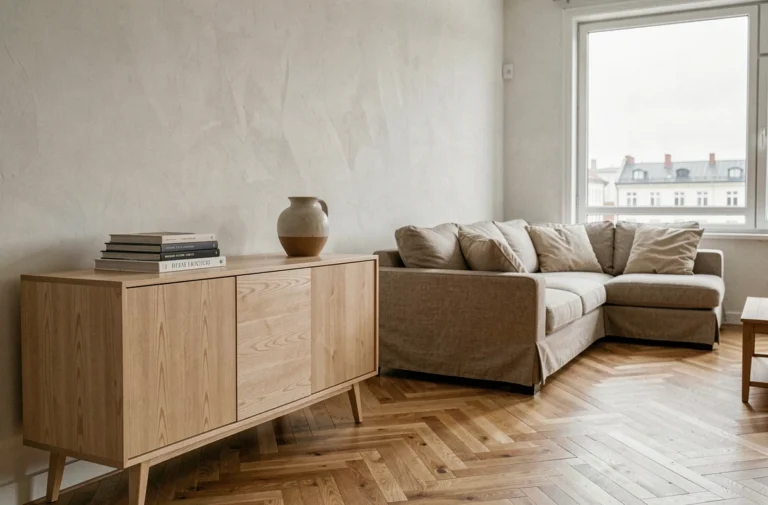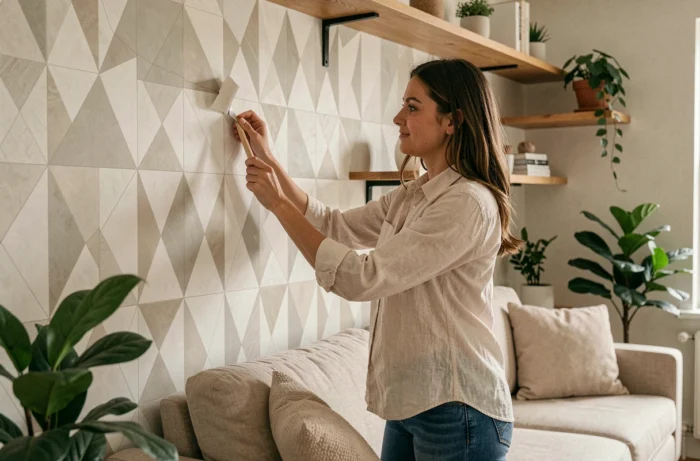
Customizing an interior means making choices about what to keep, what to transform, and what to add. The challenge lies not in a lack of ideas, but in the risk of visual overload when purchases accumulate without an overall logic. The ten tips that follow are based on a common principle: each modification should serve a concrete purpose or correct a spatial flaw, not just be “pretty.”
1. Audit the existing before any purchase using the tri-category method
Before looking for furniture or accessories, a recent method recommends categorizing each item in the room into three categories: keep, repair or update, give away or sell. This sorting helps verify the available dimensions and avoid the classic mistake of buying furniture that is too large for the remaining space.
This preparatory work transforms customization into a coherent project. By starting from what already exists, you limit expenses and reduce the visual overload caused by unplanned accumulations.
To extend this structured layout approach, Nuxo’s decor tips provide concrete ideas tailored to different housing configurations.
2. Foldable desk for dual-use spaces
Remote work now involves a significant portion of private sector employees. According to an Insee-Dares study published in 2025, 22% of private sector employees work remotely at least once a month. The likelihood of remote work increases when the available space per person is larger, prompting small homes to find reversible solutions.
A wall-mounted foldable desk can be tucked away after the workday, freeing up the room for its primary use (living room, bedroom). The trick is to choose a tabletop that does not exceed 40 cm in depth when folded, to avoid encroaching on circulation.
3. Lightweight visual separation to redefine a room without construction
A wooden screen, a thick curtain on a rod, or an open shelf positioned perpendicular to the wall is enough to create two distinct zones within the same space. This technique works particularly well in a living room-office or studio.
The lightweight separation structures the space without reducing brightness. Unlike a solid partition, it can be dismantled in minutes, making it compatible with rental housing.
4. Color-block painting to sculpt volumes
Painting a wall or door frame in a contrasting shade alters the perception of volume. Color-blocking involves applying color to a geometrically defined area using masking tape, without necessarily covering the entire wall.
A dark color block behind a low piece of furniture creates a sense of depth. Conversely, a light shade on a sloped ceiling visually pushes the height away. The cost is limited to a can of paint and a few hours of application.
5. Wallpaper in the back of furniture for targeted updating
Wallpapering the interior of an open bookshelf or the back of a china cabinet with patterned wallpaper transforms a mundane piece of furniture into a strong decorative element. The advantage: the area to cover is small, so the budget remains minimal, even with high-end wallpaper.
This trick also works on closet doors. A repositionable adhesive strip allows you to test a pattern without commitment and to remove it cleanly at the end of the lease.
6. Upcycled furniture rather than standardized new furniture
Second-hand becomes more relevant when preceded by an audit of the existing (see tip 1). A solid wood dresser found at a flea market, sanded and repainted in satin lacquer, often costs less than a new particleboard piece, for superior durability.
Reusing furniture also fits into a broader logic. In France, the PEMD diagnosis (products, equipment, materials, and waste) already regulates certain demolition or significant renovation operations exceeding 1,000 m² of floor area, under the AGEC law. Even at the individual level, considering reuse before buying new reduces the environmental impact of decoration.
7. Coordinated textiles to unify a living room without changing everything
Simultaneously replacing cushions, the sofa throw, and curtains with a palette of two or three harmonized colors is enough to radically change the atmosphere of a living room. Textiles are the quickest and least expensive transformation lever.
- Choose a dominant color for the curtains (the largest visible textile surface).
- Use a complementary shade on the cushions and throw.
- Add a contrasting accent on a single item (a cushion, a table runner) to avoid monotony.
8. Layered lighting to replace the single ceiling fixture
A central ceiling fixture produces flat light that flattens volumes. The layered lighting technique overlays three levels: ambient lighting (pendant or string lights), functional lighting (desk lamp, reading lamp), and accent lighting (adjustable spot or LED strips behind furniture).
Multiplying light sources allows you to modulate the atmosphere according to the time of day. A dimmer on the main pendant provides additional flexibility without adding a fixture.
9. Composed wall gallery to dress a large empty wall
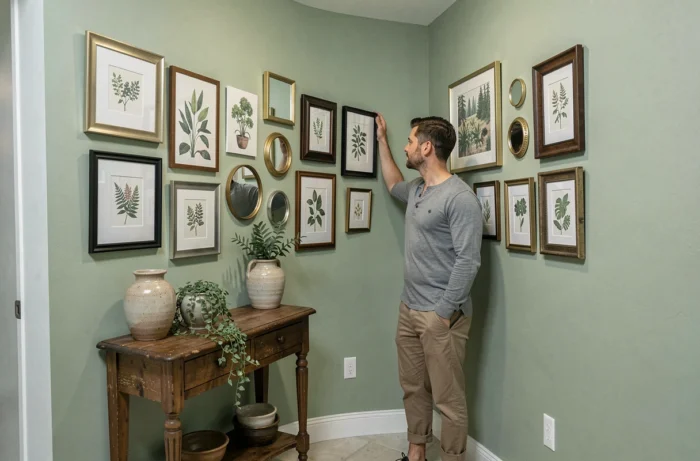
Hanging a single frame on a three-meter wall creates a lost effect. A composed wall gallery groups frames, illustrations, and small objects (round mirror, narrow shelf) into a coherent ensemble. The most reliable method is to arrange all elements on the floor, trace their outlines on kraft paper, then attach the template to the wall before drilling.
Mixing formats (a large central frame surrounded by smaller ones) creates a visual rhythm that a regular grid does not offer. Varying frame types (wood, metal, frameless) adds texture without overcrowding.
10. Defining rugs to structure an open space
In an open living area, a rug placed under the coffee table and sofa visually defines the living room zone. A second rug under the dining table marks the dining area. This textile delimitation replaces partitions and guides circulation.
- The living room rug should be large enough for the front legs of the sofa to rest on it.
- Under the dining table, allow at least 60 cm of overhang on each side so that chairs remain on the rug even when pulled out.
- In a hallway or entryway, a narrow rug (runner type) structures the passage and absorbs sound.
A personalized interior is not built by adding objects, but by organizing those that matter. The initial sorting, the choice of reversible modifications, and the coherence of textiles or lighting produce a clearer result than any decorative accumulation.